
The Story of Moses: A Comprehensive Summary
Moses’ narrative, from birth amidst Pharaoh’s decree to leading the Israelites from Egyptian slavery, is a foundational biblical tale.
Numerous resources, including detailed PDF summaries, explore this pivotal story.
Early Life and Birth
Moses’ beginnings are steeped in peril; born a Hebrew during Pharaoh’s decree to drown male infants, his life hung in the balance. Detailed PDF summaries of his story reveal he was hidden by his mother, then miraculously discovered by Pharaoh’s daughter.
Raised within the Egyptian court, yet aware of his Hebrew heritage, Moses’ early life foreshadowed his destiny. These foundational events, extensively documented in resources like the Book of Exodus and accompanying analyses, set the stage for his future role.
Pharaoh’s Decree and Moses’ Rescue
Fearing the growing Israelite population, Pharaoh ordered the death of all Hebrew male infants – a decree central to Moses’ story, thoroughly explored in PDF summaries. However, Moses’ mother cleverly concealed him.
Miraculously, he was discovered by Pharaoh’s daughter while floating in a basket on the Nile. Compassion led her to raise him as her own, unknowingly saving the future liberator. This dramatic rescue, detailed in biblical texts and related PDF resources, is pivotal.
Moses’ Upbringing in Egypt
Raised within Pharaoh’s household, Moses received an Egyptian education, a privilege unavailable to his Hebrew brethren. Despite this royal upbringing, he remained aware of his heritage and the suffering of his people – a key element detailed in story summaries available as PDFs.
This unique position allowed him to observe Egyptian power dynamics, knowledge that would later prove crucial. Numerous online PDF resources delve into the complexities of his dual identity and formative years within the palace walls.
Flight to Midian and Family Life
After killing an Egyptian overseer, Moses fled to Midian, seeking refuge from Pharaoh’s wrath. There, he encountered Jethro’s daughters and eventually married Zipporah, becoming a shepherd – a period often highlighted in concise story overviews found in PDF format.
This pastoral life fostered humility and prepared him for his divine calling. Detailed PDF summaries explore this transformative period, emphasizing the importance of his family life in shaping his character before returning to Egypt.

The Burning Bush and God’s Call
Moses’ encounter with the burning bush at Mount Horeb marked God’s call to liberate the Israelites; detailed PDF summaries outline this pivotal moment.
The Encounter at Mount Horeb
Moses, tending Jethro’s flock, experienced a theophany at Mount Horeb – a burning bush that wasn’t consumed. This divine encounter initiated God’s plan to deliver the Israelites from Egyptian bondage. PDF resources detailing the story emphasize the bush as a symbol of God’s presence and power. God commanded Moses to return to Egypt and confront Pharaoh, initiating a series of events detailed in Exodus. This pivotal moment, readily available in comprehensive PDF summaries, fundamentally altered Moses’ destiny and the course of history.
God’s Name Revealed
During the Mount Horeb encounter, God revealed a crucial aspect of His being to Moses – His name, often rendered as “I AM WHO I AM” (YHWH). This declaration signifies God’s self-existence and eternal nature. PDF summaries of the story highlight the significance of this revelation, establishing a personal covenant with Moses and the Israelites. Understanding God’s name is central to grasping the narrative, as detailed in readily available PDF resources exploring the Exodus account.
Moses’ Reluctance and Aaron’s Role
Initially, Moses expressed deep reluctance to confront Pharaoh, citing his lack of eloquence. Recognizing this, God appointed Moses’ brother, Aaron, as his spokesperson. Aaron would deliver God’s messages and perform signs, effectively bridging the communication gap; PDF summaries of the story emphasize Aaron’s vital role as Moses’ voice, facilitating the initial demands for the Israelites’ release, as detailed in accessible PDF resources outlining the Exodus narrative.

Confrontation with Pharaoh and the Ten Plagues
Moses and Aaron demanded Pharaoh release the Israelites, initiating a divine showdown marked by ten devastating plagues, thoroughly documented in PDF summaries.
Initial Demands and Pharaoh’s Resistance
Moses, empowered by God, and his brother Aaron approached Pharaoh with a direct request: to allow the Israelites to leave Egypt for three days to worship their God. This initial plea, however, met with staunch resistance from the Egyptian ruler. Pharaoh, unwilling to relinquish the Israelite workforce, not only refused the request but also intensified their labor.
Detailed PDF summaries of the Exodus narrative highlight Pharaoh’s escalating defiance as a key element in triggering the subsequent series of divine plagues. His hardened heart set the stage for a dramatic confrontation between divine power and earthly authority, a conflict extensively analyzed in scholarly resources.
The Ten Plagues in Detail
God unleashed ten devastating plagues upon Egypt, each targeting aspects of Egyptian life and demonstrating divine power over their gods. These included water turning to blood, swarms of frogs, gnats, flies, livestock pestilence, boils, hail, locusts, darkness, and finally, the death of the firstborn sons.
PDF summaries meticulously detail each plague’s progression and impact, illustrating Pharaoh’s incremental yielding followed by renewed resistance. These accounts emphasize the plagues as not merely punishments, but demonstrations intended to compel recognition of the one true God, a central theme explored in biblical analyses.
The Plague of Darkness and the Final Plague
A palpable darkness descended upon Egypt for three days, a suffocating gloom that Egyptians could not penetrate, intensifying their suffering and highlighting God’s dominion. This was followed by the most devastating plague: the death of every Egyptian firstborn son.
PDF resources examining the Exodus detail how this final plague broke Pharaoh’s resistance, prompting him to finally release the Israelites. Analyses within these summaries often explore the symbolic weight of the firstborn’s death and its connection to the Passover sacrifice.

The Exodus from Egypt
Following the plagues, Moses led the Israelites’ departure from Egypt, initiating the Exodus—a pivotal event detailed in PDF summaries of the biblical story.
The Passover and the Departure
The Passover, commemorating God’s deliverance, involved a sacrificial lamb and marking doorposts with blood, protecting Israelites from the final plague—the death of firstborn sons.
Subsequently, Pharaoh relented, and Moses led the Israelites’ exodus from Egypt. Detailed PDF resources comprehensively outline this pivotal event, exploring its religious significance and historical context.
These summaries often highlight the symbolic weight of the Passover and its enduring legacy within Jewish tradition, alongside the challenges faced during the departure.
Crossing the Red Sea
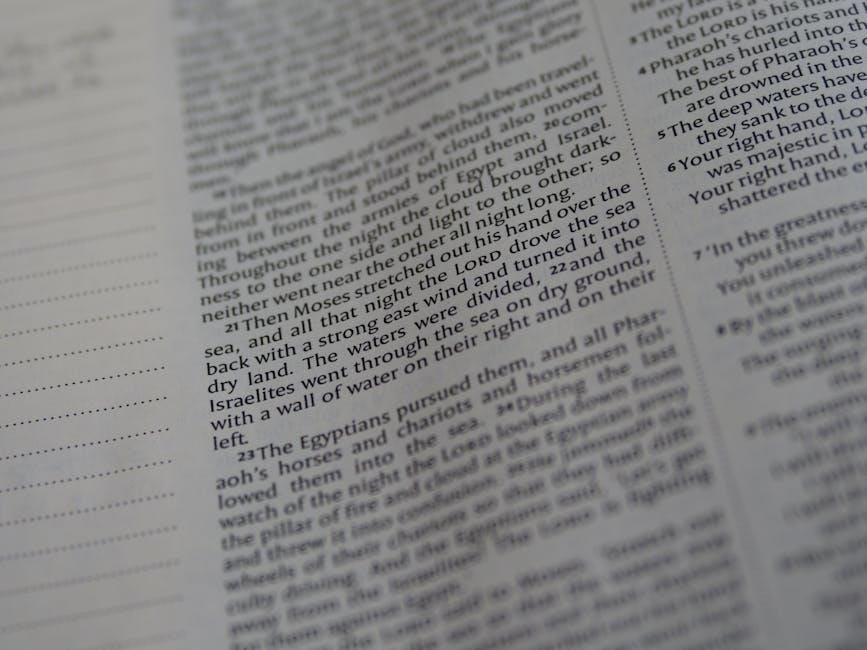
Following their departure, Moses led the Israelites to the Red Sea, where they were pursued by Pharaoh’s army. God miraculously parted the waters, allowing the Israelites to cross on dry ground.
However, when the Egyptians followed, the sea closed, engulfing them. PDF summaries detail this dramatic event, often referencing potential ancient routes and archaeological findings.
These resources explore the symbolic importance of this crossing as a demonstration of God’s power and a defining moment in the Israelites’ liberation.
The Song of Moses and Miriam
After the miraculous crossing of the Red Sea, Moses and Miriam led the Israelites in a song of praise and thanksgiving to God for their deliverance from Egyptian bondage.
This song, detailed in Exodus 15, celebrates God’s power and victory over Pharaoh’s army. PDF summaries often analyze the poetic structure and theological themes within the song.
It represents a pivotal moment of communal worship and a declaration of faith in God’s unwavering commitment to His people.

Journey to Mount Sinai
Following the Exodus, the Israelites journeyed to Mount Sinai, where Moses received the Ten Commandments and established a covenant with God. PDF resources detail this pivotal event.
Wandering in the Wilderness
After leaving Egypt, the Israelites faced forty years of wandering in the wilderness due to their lack of faith and repeated disobedience. PDF summaries highlight God’s provision during this time, notably manna from heaven and water miraculously sourced from rock.
This period tested their resilience and solidified their reliance on divine guidance. Detailed accounts, often found in downloadable PDF formats, explore the challenges and lessons learned during this prolonged journey, shaping their identity as a nation.
Manna from Heaven and Water from the Rock
Throughout their wilderness journey, God miraculously sustained the Israelites with manna, a bread-like substance appearing each morning, and water from a rock struck by Moses’ staff. PDF summaries detail these provisions as demonstrations of God’s faithfulness.
These events, extensively documented in the Book of Exodus and readily available in PDF format, symbolize divine sustenance and reliance on God’s provision during times of hardship, reinforcing faith amidst adversity.
The Ten Commandments
At Mount Sinai, God revealed the Ten Commandments to Moses, foundational moral and religious principles for the Israelites – and humanity. These laws, outlining proper worship and ethical conduct, are central to the story.
Detailed PDF resources comprehensively explain each commandment’s significance, offering insights into their historical context and enduring relevance. Studying these principles, often found in summarized PDF form, remains vital for understanding Judeo-Christian ethics.
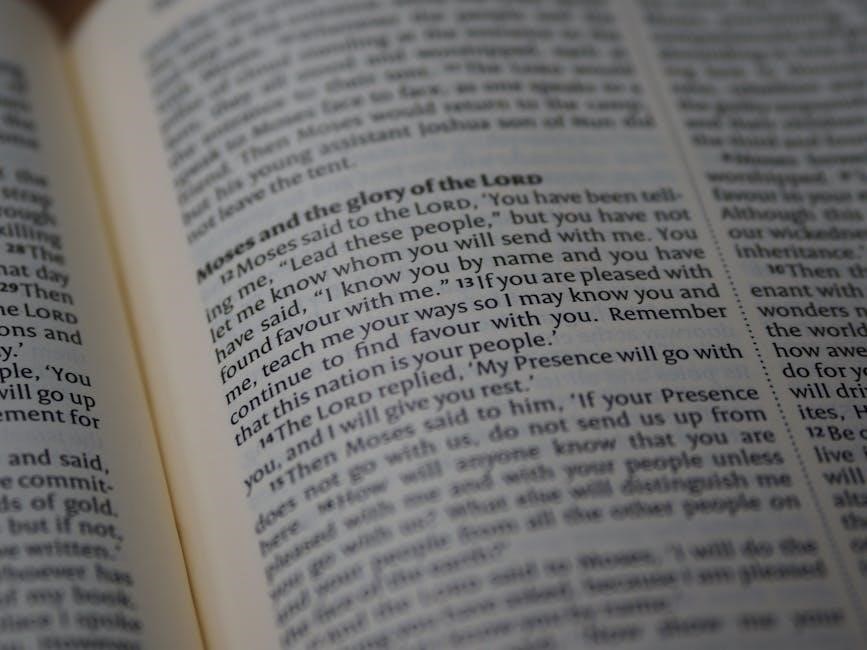
The Golden Calf and Renewal of the Covenant
While Moses received the Ten Commandments, the Israelites created a golden calf, prompting God’s wrath; a renewed covenant, detailed in PDF summaries, followed.
Aaron’s Involvement and the Idol
Aaron, left in charge during Moses’ absence atop Mount Sinai, succumbed to the Israelites’ demands for a tangible god. He facilitated the creation of a golden calf, melting down gold jewelry and fashioning the idol. This act of worship, a direct violation of God’s commandment against graven images, ignited divine anger. PDF resources detailing the story emphasize Aaron’s weakness and the people’s impatience as key factors. His role demonstrates the challenges of leadership and the allure of idolatry, even amongst those recently freed from oppression. This pivotal moment tested the fledgling covenant.
Moses’ Intercession and God’s Wrath
Upon descending Mount Sinai with the Ten Commandments, Moses witnessed the Israelites’ idolatrous worship of the golden calf. Filled with righteous anger, he shattered the tablets. However, he then interceded with God on behalf of the people, pleading for forgiveness. PDF summaries highlight this as a crucial moment, showcasing Moses’ compassionate leadership. God’s initial wrath threatened complete destruction, but Moses’ fervent prayer stayed His hand, demonstrating the power of repentance and divine mercy, though consequences followed.
The Second Set of Tablets
Following the destruction of the first tablets, Moses ascended Mount Sinai once more, imploring God for renewed covenant. God granted his request, instructing him to carve two new stone tablets. These second tablets mirrored the first, reaffirming the Ten Commandments. PDF resources emphasize this act as a symbol of God’s enduring faithfulness and willingness to restore the relationship with Israel, despite their initial transgression, offering a second chance for obedience.

Leadership and Challenges in the Wilderness
Moses faced constant trials leading the Israelites, including rebellion and disbelief, as detailed in numerous PDF summaries of his journey through the harsh wilderness.
Spies Sent to Canaan
Moses dispatched twelve spies to assess Canaan, the promised land, before the Israelites’ entry. Detailed in PDF summaries of the Exodus, ten returned with discouraging reports, exaggerating the land’s difficulties and the strength of its inhabitants.
This sparked widespread fear and rebellion among the people, questioning God’s promise. Only Joshua and Caleb offered a positive assessment, trusting in God’s power to deliver them. Their lack of faith resulted in a forty-year delay in entering Canaan, a consequence thoroughly explored in available resources.
Rebellion and Disobedience
Throughout their wilderness journey, the Israelites repeatedly rebelled against Moses and God, as detailed in numerous PDF summaries of the Exodus narrative. Complaints about food, water, and leadership were frequent, demonstrating a lack of trust and faith.
These acts of disobedience, including questioning God’s provision and desiring a return to Egypt, consistently led to consequences, highlighting the importance of obedience and reliance on divine guidance, a central theme explored within these resources.
Forty Years of Wandering
As punishment for their lack of faith and repeated disobedience, the Israelites endured forty years of wandering in the wilderness, a period extensively covered in PDF summaries of the story of Moses. This prolonged journey tested their resilience and commitment to God.
During this time, God continued to provide for them, offering manna and water, while also refining their faith and preparing them for entry into the Promised Land, a crucial aspect detailed in available resources.
Moses’ Final Days and Succession
Moses, denied entry to the Promised Land, delivered a farewell address and transferred leadership to Joshua, as detailed in PDF summaries of his story.
The Promise of the Promised Land
Moses, despite his disobedience, was permitted to view the Promised Land from Mount Nebo, a symbolic gesture of God’s enduring covenant with Israel. PDF resources detailing the story emphasize this bittersweet moment. Though he wouldn’t physically enter Canaan, the vision affirmed God’s commitment to fulfilling the promise made to Abraham. This act served as encouragement for the Israelites, preparing them for the challenges ahead under Joshua’s leadership. Detailed summaries available in PDF format explore the theological significance of this pivotal event, highlighting themes of faith, obedience, and divine grace.
Moses’ Farewell Address
Before his death, Moses delivered a poignant farewell address to the Israelites, recounted extensively in Deuteronomy. PDF summaries of the story highlight his exhortations to remain faithful to God’s covenant and obey His commandments. He warned against idolatry and urged them to remember God’s past faithfulness. This address, readily available in comprehensive PDF studies, served as a final plea for their spiritual well-being and a preparation for life in the Promised Land, emphasizing the importance of continued devotion and adherence to divine law.
The Transfer of Leadership to Joshua
Recognizing his impending death, Moses formally transferred leadership to Joshua, a courageous and faithful servant. Detailed PDF resources summarizing the story emphasize God’s direct command and affirmation of Joshua as his successor. Moses publicly commissioned Joshua before the Israelites, urging them to support him. This pivotal moment, thoroughly documented in PDF analyses, ensured a smooth transition and continued guidance as they prepared to conquer Canaan, solidifying faith in God’s continued provision.
Archaeological Evidence and the Exodus Story
PDF summaries detail recent archaeological finds – ancient fortresses and copper smelting workshops – potentially linking to the biblical Exodus narrative, offering tangible support.
Ancient Fortresses and Routes
PDF analyses of the story of Moses frequently reference newly discovered archaeological sites. A massive 3,000-year-old fortress in Egypt, along an ancient route, is believed to have been traveled during the biblical Exodus. This stronghold’s recent unearthing provides potential physical evidence supporting the Israelites’ journey. Researchers are examining these routes, comparing them to descriptions within the Book of Exodus, seeking corroboration of the biblical account. These findings, detailed in numerous PDF resources, offer compelling insights into the historical context.
Copper Smelting Workshops in Egypt
Recent archaeological discoveries, often detailed in PDF summaries of the story of Moses, include an ancient copper smelting workshop unearthed in Egypt. This workshop, alongside other buildings and observation points, potentially links to the biblical narrative. The discovery suggests the Israelites possessed the metallurgical skills described in Exodus, supporting claims of their extended stay and labor in Egypt. PDF reports from the Egyptian Ministry of Tourism and Antiquities highlight this evidence, fueling ongoing debate and research.
Potential Links to Biblical Accounts
Archaeological findings, comprehensively documented in numerous PDF summaries of the story of Moses, offer intriguing potential connections to the Exodus narrative. The unearthed fortress along a likely Exodus route and the copper smelting workshops suggest a historical basis for biblical events. While not definitive proof, these discoveries bolster arguments for the plausibility of the biblical account, prompting further investigation and detailed analysis available in scholarly PDF resources.
The Story of Moses in Religious Tradition
Moses holds immense significance across Judaism, Christianity, and Islam, revered as a pivotal prophet and lawgiver; detailed PDF summaries explore this deeply.
Moses as the Greatest Prophet
Moses consistently ranks as the most important prophet in Judaism, uniquely receiving the Torah directly from God at Mount Sinai. He’s considered the foundational figure, whose laws and teachings shape Jewish life.
Christianity views Moses as a precursor to Jesus Christ, recognizing parallels in their roles as deliverers and lawgivers. Islamic tradition also reveres Moses (Musa) as a significant prophet, detailing his story in the Quran.
Numerous PDF resources and scholarly analyses delve into his prophetic role, offering comprehensive summaries of his life and enduring legacy across faiths.
Significance in Judaism
Moses is central to Jewish identity, embodying liberation from oppression and the covenant with God. The entire Jewish legal and ethical framework stems from his receiving the Ten Commandments.
His leadership during the Exodus defines the Jewish narrative of freedom and nationhood. Jewish holidays like Passover commemorate this pivotal event.
Detailed PDF summaries of the story of Moses, alongside scholarly texts, are readily available, exploring his profound and lasting impact on Jewish faith, law, and culture.
Moses in Christianity and Islam
Moses holds a revered position in both Christianity and Islam, recognized as a crucial prophet preceding Jesus and Muhammad, respectively. Christians view him as a precursor to Christ, fulfilling Old Testament prophecies.
In Islam, Moses (Musa) is considered a significant messenger of God, mentioned frequently in the Quran. Both faiths acknowledge his role in receiving divine law.
Numerous PDF resources summarizing the story of Moses highlight his universal significance, demonstrating his enduring influence across Abrahamic religions.

The Chosen Series and Modern Interpretations
Dallas Jenkins’ “The Chosen” and other modern media reimagine Moses’ tale, sparking renewed interest; PDF summaries offer context to these interpretations.
Dallas Jenkins’ 5amp;2 Studios
Dallas Jenkins, creator of “The Chosen,” has expanded his vision with 5amp;2 Studios, unveiling a diverse slate of projects. These include animated series and unscripted shows featuring figures like Bear Grylls. This expansion demonstrates a commitment to innovative biblical storytelling. For those seeking foundational understanding, readily available PDF summaries of the story of Moses provide essential context to appreciate these modern adaptations and their connection to the original narrative. Jenkins’ work aims to make these ancient stories accessible to a wider audience.
Animated Series and Unscripted Shows
5amp;2 Studios is developing both animated series and unscripted shows, broadening the reach of biblical narratives. These projects aim to engage audiences through diverse formats, complementing existing resources like comprehensive PDF summaries of the story of Moses. The unscripted show with Bear Grylls offers a unique lens. These modern interpretations encourage deeper exploration of the foundational texts, providing accessible entry points for those unfamiliar with the detailed accounts found within the Book of Exodus.
Contemporary Relevance of the Moses Story
The enduring story of Moses continues to resonate today, exploring themes of freedom, leadership, and faith. Modern audiences find parallels in struggles against oppression and the pursuit of justice. Accessible resources, such as detailed PDF summaries, facilitate understanding. The narrative’s power lies in its universal message, prompting reflection on personal and societal challenges, while contemporary adaptations, like those from 5amp;2 Studios, ensure its continued cultural impact.

PDF Resources and Further Study
PDF summaries, scholarly articles, and digital copies of Exodus offer in-depth exploration of Moses’ life; These resources provide comprehensive analysis and historical context.
Online Summaries and Analyses
Numerous websites present concise summaries of the Moses narrative, often derived from the Book of Exodus. These online resources frequently offer chapter-by-chapter breakdowns, character analyses, and thematic explorations. Searching for “story of Moses summary PDF” yields downloadable documents providing detailed overviews. BibleProject and other theological sites offer insightful video and textual analyses, while academic platforms host scholarly articles dissecting the historical and literary aspects of the story. These digital tools cater to diverse learning preferences, from quick overviews to in-depth studies.
Scholarly Articles and Books
Beyond simple summaries, academic exploration delves into the story of Moses with rigorous analysis. Scholarly articles, accessible through JSTOR and similar databases, examine historical context and textual criticism. Books like “Moses the Egyptian” by Jan Assmann offer alternative perspectives. While a direct “story of Moses summary PDF” from these sources is rare, comprehensive commentaries on Exodus provide detailed chapter analyses. These resources explore the narrative’s theological implications, archaeological connections, and literary artistry, offering a nuanced understanding.
Digital Copies of the Book of Exodus
Numerous websites offer free access to the Book of Exodus in various translations. Bible Gateway and Blue Letter Bible provide searchable text, alongside audio versions. While a single “story of Moses summary PDF” isn’t always directly available on these platforms, reading Exodus itself provides the complete narrative. Many study Bibles, available digitally, include chapter summaries and notes. Project Gutenberg also hosts older translations in accessible formats, aiding research and deeper understanding of the foundational text.
Be First to Comment